What to Look for When Buying a Fixer Upper
What to Look for When Buying a Fixer Upper
What to Look for When Buying a Fixer Upper
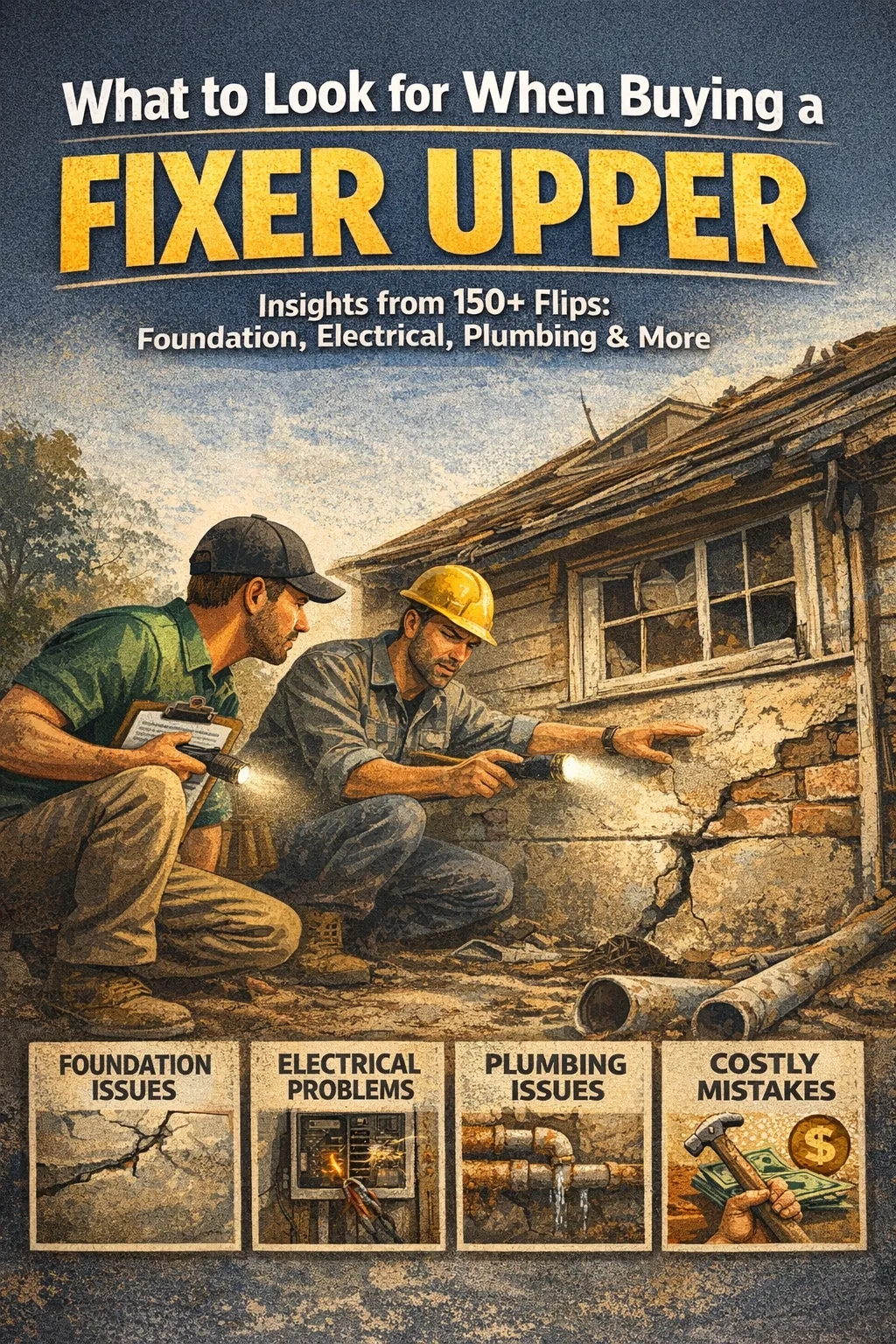
Knowing what to look for when buying a fixer upper separates profitable deals from money pits.
Miss a major issue during your walkthrough, and you could blow your budget by $20,000, $30,000, or more.
Catch it upfront, and you either negotiate a lower price or walk away before you're committed.
After 8 years in real estate investment and 4 years of flipping houses personally, I've learned which issues kill deals and which ones just need budget adjustments.
This guide walks through exactly what to inspect, which red flags mean you should walk away, and the costly mistakes newer investors make.
The Top Red Flags That Make You Walk Away
Some issues aren't worth fixing. Here's what makes me walk away immediately:
Foundation Issues
Foundation problems are deal killers.
Look for cracks in the exterior walls, slopage in the floors, and signs of water intrusion.
Foundation repairs can run $5,000 to $50,000+ depending on severity. If you see significant cracking, settling, or movement, get a structural engineer's opinion before proceeding.
Small hairline cracks in concrete might be cosmetic. Large diagonal cracks, stair-stepping in brick, or doors that won't close properly signal serious structural issues.
Electrical Problems (Especially in Atlanta)
Electrical is a huge concern with older houses in Atlanta.
A lot of the houses we buy were built in the 50s, 60s, or 70s. The electrical has never been updated.
Many times there's not even enough power coming into the house to realistically support the home.
Here's the problem:
We go into houses that are 100% electric—heat, water heater, stove/oven—and the house only has 100-150 amp service.
For a bigger house, we'd likely either have to convert some of those appliances to gas or upgrade the electrical service coming into the house. Which can be super expensive.
When we find a house with 150 amps, we'd obviously prefer it to have 200 amps. But if the house already has gas, a lot of times we'll make sure all three of those major appliances are switched to gas so we don't have to upgrade the service.
Upgrading electrical service can cost $5,000 to $15,000+ depending on the scope. Factor that into your budget if the house has inadequate amperage.
Water Intrusion and Drainage Issues
Water is the enemy of every house.
Look for signs of water damage: stains on ceilings, warped floors, musty smells, mold, or visible moisture in basements or crawl spaces.
Check the grading around the foundation. Water should flow away from the house, not toward it.
Inspect gutters and downspouts. Are they functional? Do they direct water away from the foundation?
Real example:
We bought a house that was mid-renovation from another fix-and-flip investor. He told us he was selling to reinvest in another project.
The day before closing, we found out the basement was leaking and there was a bunch of water intrusion. The basement was literally flooded.
We thought we could add that to the budget, so we continued with closing.
Then after we closed, we figured out the electrical didn't have enough power to support the house. Luckily the house had gas, which saved us.
But then we figured out we had to replace the entire gas line because it was galvanized steel, which rusts badly on the inside. We didn't realize that.
We're way over budget on this house, and I wish we would have walked away.
But this can happen to anyone. Sometimes there are things missed in walkthroughs or inspections. All you can do is pull the pieces back together as best you can, learn from it, and move forward.
Major Systems to Inspect
After checking for red flags, inspect the major systems that drive your budget.
Roof
The roof protects everything else.
Check the age. Most roofs last 15-25 years depending on material.
Look for missing or damaged shingles, sagging sections, or visible holes.
Go into the attic if possible. Check for daylight coming through, water stains, or damaged decking.
Roof replacement costs $8,000 to $20,000+ depending on size and material.
HVAC
Test the heating and air conditioning.
Turn on the system. Does it blow hot/cold air? How loud is it? Does it cycle properly?
Check the age. HVAC systems typically last 10-15 years.
Budget $5,000 to $12,000+ for replacement if the system is old or non-functional.
Plumbing
Turn on every faucet. Flush every toilet. Check water pressure and drainage.
Look under sinks for leaks or water damage.
Inspect visible pipes. Galvanized steel pipes are outdated and prone to rust and blockages. PEX or copper is preferred.
If you see galvanized pipes, budget for repiping. Full house replumbing can cost $4,000 to $15,000+.
Electrical Beyond Amperage
Beyond checking amperage, inspect the electrical panel.
Look for:
Outdated fuse boxes (should be replaced with breaker panels)
Scorching or burn marks near breakers
Aluminum wiring (fire hazard, should be replaced)
Knob-and-tube wiring (very old, needs full rewire)
Real example from Joyland Park:
I bought 2 houses in the Joyland Park subdivision in Southwest Atlanta. I love that neighborhood.
These weren't from the same seller, but we figured out after purchasing them that there must have been an "electrician" in the neighborhood who worked on a lot of houses in the area and "rewired" them. He had no idea what he was doing.
We were told both houses had been rewired. But when we went into the attics, we figured out that all the wires were spliced.
The person had literally taken smaller pieces of wire, stripped the insulation, twisted the copper together, and created extended electrical runs by splicing shorter pieces together.
It was an absolute mess and a serious fire hazard. We ended up having to completely rewire both houses.
Budget $5,000 to $15,000+ for full electrical rewiring depending on the size of the house.
What Newer Investors Commonly Overlook
Even with a checklist, newer investors miss things that blow budgets.
Windows
Windows are one of the most overlooked expenses.
When you actually have to replace windows, you don't realize how expensive they are until you're counting them and doing the math.
Windows are freaking expensive.
However, a lot of times investors think they need to replace windows when in reality you don't.
Real example:
Our house that we flipped in Lithonia—the one that sold for $354k when everyone thought it would sell under $300k—everyone was telling us the budget was $100k and that we needed to replace the windows.
But we didn't. We just painted them.
And we literally didn't get a single complaint about it.
Sometimes you just need to know what your finished product is going to be. If you know you're gonna be able to overcome things like not having new windows, then don't replace those windows.
Save that $5,000 to $15,000+ for something that actually impacts value.
Permits and Code Violations
Check with the county for open permits or code violations.
Unpermitted work surfaces during inspections when you go to sell. Buyers' lenders won't approve financing until violations are cleared.
Fixing unpermitted work can delay closings or kill deals entirely.
Mold and Environmental Issues
Mold remediation costs add up fast.
Check basements, crawl spaces, bathrooms, and attics for visible mold or musty smells.
Budget $1,000 to $10,000+ depending on severity.
Also check for asbestos (common in older homes), lead paint (pre-1978 homes), and radon (test kits available).
Outdated Plumbing Materials
Galvanized steel pipes rust from the inside out. Polybutylene pipes (common in 80s/90s homes) are prone to failure.
If you see either, budget for replacement. Ignoring old plumbing leads to leaks, low water pressure, and expensive emergency repairs mid-renovation.
Cosmetic vs. Structural: Know the Difference
Not every issue requires immediate action.
Cosmetic issues:
Outdated finishes
Worn flooring
Ugly paint colors
Old cabinets
Dated fixtures
These are easy fixes. Budget them, but they won't kill your deal.
Structural issues:
Foundation problems
Roof failure
Major water intrusion
Electrical fire hazards
Inadequate HVAC or plumbing systems
These are expensive and sometimes deal killers. Catch them early or walk away.
How to Inspect a Fixer Upper Properly
Don't rush your walkthrough. Take your time and be thorough.
Bring a contractor. Their experienced eye catches things you'll miss.
Take photos and notes. Document everything. You'll need this for your budget and negotiations.
Test everything. Turn on faucets, flush toilets, flip breakers, test HVAC, open and close doors and windows.
Check the attic and basement/crawlspace. These areas reveal hidden issues.
Look for signs of DIY work. Amateur electrical, plumbing, or structural work often creates problems.
Walk the exterior. Check grading, drainage, siding, soffits, and fascia.
After 8 years and over 10,000 underwriting experiences, I can walk a property and estimate repairs in 15-20 minutes.
When you start out, expect walkthroughs to take 60+ minutes.
Don't rush it. Missing a $20,000 issue because you hurried costs way more than spending an extra 30 minutes on-site.
Estimating Repair Costs Accurately
Once you know what needs fixing, estimate costs.
Big-ticket items:
Foundation: $5,000-$50,000+
Roof: $8,000-$20,000+
HVAC: $5,000-$12,000+
Plumbing (repipe): $4,000-$15,000+
Electrical (rewire): $5,000-$15,000+
Cosmetic work:
Kitchens: $8,000-$25,000+
Bathrooms: $4,000-$10,000+ each
Flooring: $3-$8/sq ft installed
Paint: $2,000-$5,000 whole house
Landscaping: $1,000-$5,000+
Always add 10-15% contingency for surprises.
Things will go wrong. Budget for it upfront.
When you work with The von Group, we provide complete estimated breakdowns showing projected ARV, all costs, and estimated net profit based on our experience with 150+ deals.
Age of the House Matters
The older the house, the more you need to scrutinize systems.
Houses built in the 1950s-1970s likely need:
Electrical upgrades
Plumbing replacement
HVAC replacement
Potential asbestos or lead paint remediation
Houses built in the 1980s-1990s:
Check for polybutylene plumbing
HVAC systems nearing end of life
Original roofs likely due for replacement
Houses built in 2000+:
Fewer major system issues
Focus on cosmetic updates
In Atlanta, most of our deals are older homes. We buy properties inside the perimeter and in the suburbs within an hour of Atlanta.
We know that the older the house, the more we need to look at things like electrical and plumbing.
Neighborhood-Specific Knowledge Matters
Here's something most investors, almost all wholesalers, and even most agents don't know: a comp 0.2 miles away could be selling for $200k more than your house solely because of the street it's on.
We know this because we actually flip houses.
Once you really know the neighborhoods and you know the streets, you know exactly what the house can sell for and you know the exact finishes that are in high demand in the area.
That's why we excel both inside the perimeter and in the suburbs.
How to find fixer upper homes covers strategies for finding properties in different Atlanta markets.
When to Walk Away
Some deals aren't worth saving.
Walk away when:
The numbers don't work. If repairs exceed your budget and you can't negotiate the price down, pass.
Major structural issues exist. Foundation problems, severe water damage, or inadequate systems that cost more to fix than the property is worth.
You're uncomfortable with the risk. Trust your gut. If something feels off, move on.
Better opportunities exist. Don't force a marginal deal when better options are available.
I've walked away from dozens of properties over the years. Every time, I found a better deal within weeks.
How to buy a fixer upper walks through the complete acquisition process once you've found the right property.
How The von Group Pre-Vets Properties
When you buy from The von Group, we've already done the inspection work.
We walk every property. We bring contractors. We check foundation, electrical, plumbing, HVAC, roof, and structural elements.
We've underwritten over 10,000 properties. We know what to look for and what costs to expect.
When we send you a deal, it's been rigorously underwritten by someone who actually flips houses and knows the neighborhoods intimately.
We only send properties where the numbers work.
Off-market fixer upper homes explains why off-market deals often have better margins than MLS properties.
Wholesale real estate deals covers how to evaluate deals from wholesalers who may not have the same level of vetting.
Ready to Find Pre-Vetted Fixer Uppers?
The von Group provides off-market fixer uppers that have been thoroughly inspected and underwritten. We've closed 150+ deals since 2024.
First-come, first-served pricing. No hidden issues. Transparent profit analysis.
Get access to vetted fixer uppers here.
Need financing? Check our financing resources to connect with hard money lenders.
